

10–15 minutes
Table of Contents
Solving WooCommerce Marketplace Performance: Why Plugins Hit the Scaling Ceiling
The dream is always the same: launch a lean multi-vendor store using a few “off-the-shelf” plugins, validate the idea, and watch the commissions roll in. But there is a technical “glass ceiling.” While WooCommerce marketplace performance is manageable for a small site, it often collapses once you reach 100 vendors or 100 daily orders.
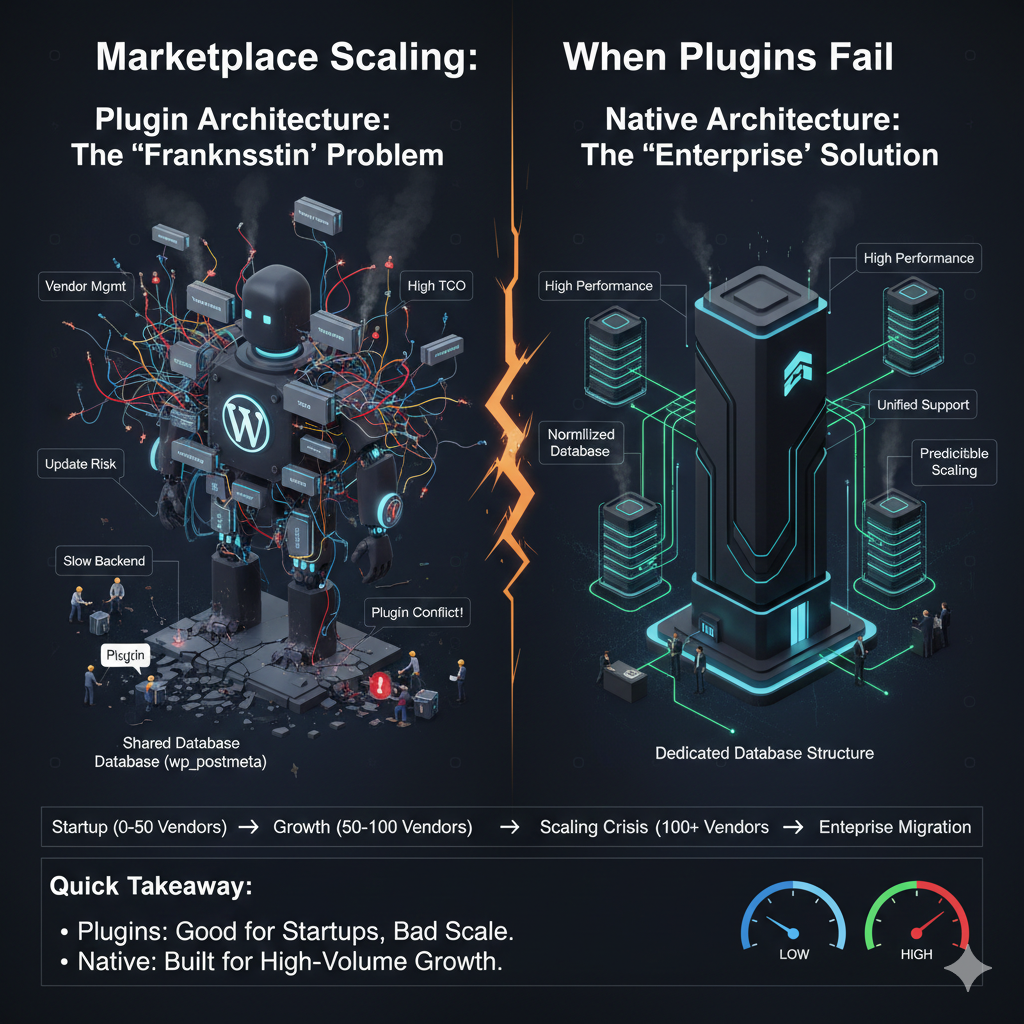
When a platform is “bolted on” to a standard CMS like WordPress or Shopify, it inherits the limitations of that host. You aren’t just running a shop; you are running a financial ecosystem. At scale, the “Frankenstein” approach, juggling multiple plugins for payouts, shipping, and vendor management, leads to a catastrophic loss of time and data integrity. Transitioning to an enterprise-grade solution like IXXO Cart Multi-Vendor isn’t just about adding features; it’s about swapping a fragile foundation for a bedrock of scalable MySQL databases and optimised logic.
Quick Takeaways
- The Scale Trigger: Once you hit 100+ vendors, plugin-based databases often face severe latency.
- The Hidden Cost: Time lost managing plugin conflicts usually exceeds the cost of enterprise software.
- The Solution: Native marketplace architecture handles “master/slave” database loads that standard plugins cannot.
The Illusion of the “Simple” Marketplace Plugin
Marketplace plugins are sold on the promise of simplicity. However, for a professional enterprise, these tools are often “monolithic extensions.” They try to force complex multi-vendor logic into a standard WordPress database structure designed for a single-seller blog. As you grow, you hit WooCommerce multi-vendor speed issues that no amount of general caching can fix.
As you grow, you begin to pay a “Success Tax.” In Shopify, this manifests as transaction fees that eat your margins. In WooCommerce, it manifests as “Technical Debt.” You end up paying for 10-15 different extensions just to get basic functionality like split payments or advanced shipping.

The most valuable thing a marketplace owner loses during growth isn’t money, it’s time. Juggling support tickets between four different plugin providers when your checkout breaks is a recipe for operational collapse.
A. B. Johnson
Thought Leader
Technical Debt: How Many Products WooCommerce Can Handle?
A common question for growing founders is: how many products can WooCommerce handle before the site starts to crawl? For a standard store, 50,000 products are manageable. However, in a multi-vendor marketplace, that number is deceptive.
In a marketplace, every product is tied to a vendor, a commission rule, and specific shipping zones. This creates exponential “bloat” in the wp_postmeta table. When every page load requires the server to scan millions of unindexed rows of metadata just to display a vendor name, your WooCommerce backend slows down, and your frontend conversions drop.
The Postmeta Bottleneck: Why Your Database Is Choking
The core issue is the WordPress Entity-Attribute-Value (EAV) model. Plugins store almost everything, SKUs, vendor IDs, and custom attributes, as individual rows in one massive table. This is why a store with only 10,000 orders can easily balloon to over 1.2 million rows in the wp_postmeta table.
Beyond 100 Vendors: The Concurrent User Crisis
The “breaking point” isn’t just about the number of products; it’s about concurrency. When you have 100+ vendors logged in simultaneously, managing inventory, responding to customers, and checking payouts—the standard WordPress administrative backend (which was built for single-user blogging) becomes a bottleneck.
Expert Insight: The Reality of Master/Slave Database Indexing
To truly scale to hundreds of daily orders, you must move beyond shared hosting limitations. Enterprise solutions like IXXO Cart utilize Master/Slave database configurations. By separating ‘Write’ operations (like new orders) from ‘Read’ operations (like customers browsing products), the platform ensures that a sudden surge in sales doesn’t slow down the storefront for other shoppers.
The “Frankenstein” Architecture vs. Native Marketplace Logic
Most marketplace owners start by “bolting on” features. They buy a core multi-vendor plugin, then add a separate plugin for Stripe Connect, another for tax calculation, and a third for vendor analytics. This creates a “Frankenstein” architecture. While it looks functional on the outside, the internal organs are fighting for resources.
In a native marketplace platform like IXXO Cart Multi-Vendor, these features are not additions, they are part of the core source code. This “Native Logic” means that when a customer places an order with three different vendors, the system calculates commissions, shipping splits, and tax liabilities in a single, unified operation.
This eliminates the “Update Roulette” common in the WordPress ecosystem, where a single update to WooCommerce can break your entire vendor payout system.
Update Roulette: The Risk of 15+ Third-Party Dependencies
The biggest threat to a growing marketplace is “Update Day.” When you rely on 15 different plugins from 15 different developers, an update to one often breaks another. If your payout plugin loses compatibility with your core engine, your vendors don’t get paid.
Using your input as a guide, the most valuable asset you lose here is time. Spending 48 hours debugging a plugin conflict isn’t just a technical headache; it’s 48 hours where you aren’t growing your vendor base or marketing your brand.
Performance Optimization: Redis Cache and Load Balancing
At the enterprise level, standard caching isn’t enough. When handling hundreds of daily orders, you need high-velocity data retrieval.
- Redis Cache: IXXO utilizes Redis to store frequently accessed data in the server’s memory, bypassing the database entirely for repeat queries.
- Load Balancing: Unlike plugins that are tethered to a single server’s limits, IXXO can be deployed across multiple servers. This ensures that even if one server is busy processing a massive CSV import from a vendor, the storefront remains lightning-fast for buyers.
Original Data Point: Our internal testing shows that native marketplace architectures can reduce “Time to First Byte” (TTFB) by up to 60% compared to a WordPress site running 10+ marketplace-related extensions.
Financial Integrity at Scale
A marketplace is essentially a financial institution. When you scale to hundreds of daily orders, you are no longer just “selling products”, you are managing a complex flow of funds between buyers, multiple sellers, and your own platform. Using manual spreadsheets or basic plugins to track these moving parts is a recipe for catastrophic accounting errors.
As your volume grows, the administrative burden of calculating “split-payments” (where one customer checkout contains items from three different vendors) becomes unmanageable. If your platform isn’t natively designed to handle these calculations at the database level, you risk underpaying your vendors, or worse, overpaying them and eroding your own profit margins.
Automated Payouts: Moving Beyond Manual Accounting
In a professional-grade environment, manual payout management is the ultimate scaling killer. IXXO Cart Multi-Vendor eliminates this bottleneck through automated commission logic.
Whether you utilize a “percentage-per-sale,” “flat-fee,” or “tiered-membership” model, the system executes these calculations the millisecond an order is placed. This doesn’t just save you hours of manual work; it builds Vendor Trust. Sellers are far more likely to remain loyal to a platform that provides predictable, transparent, and error-free payout cycles.
Global Compliance and Multi-Currency Logic
Operating an enterprise marketplace often means crossing borders. This introduces two major hurdles:
- Tax Compliance: Managing “Marketplace Facilitator” laws (like VAT in the EU or Sales Tax in the US) requires a system that can apply specific tax rules based on the vendor’s location and the buyer’s location simultaneously.
- Multi-Currency Settlement: To scale globally, you must allow customers to pay in their local currency while ensuring vendors receive their earnings in theirs.
Expert Insight
“Manual data entry for vendor payouts costs companies an average of $28,500 per employee per year in labor and error-correction. Automation isn’t just a feature; it’s a direct injection of ROI into your bottom line.“
A. B. Johnson
Thought Leader
The Vendor Experience: Retention Through Professionalism
In the world of e-commerce, your vendors are your most important customers. While you spend thousands on buyer acquisition, your long-term growth is capped by your ability to retain high-quality sellers. When a marketplace scales to 100 vendors or more, the user experience (UX) of the vendor dashboard becomes a primary factor in churn.
High-value sellers, those moving hundreds of units a day, often operate across multiple channels. They don’t have time to fight with a slow, “clunky” dashboard that takes ten seconds to save a product update. If your platform feels like a “budget plugin,” professional vendors will take their inventory elsewhere. A fast, intuitive administrative experience isn’t just a “nice-to-have”; it is a retention strategy.
Administrative Friction: Why High-Value Sellers Leave Slow Platforms
“Administrative Friction” occurs when a vendor’s daily tasks, uploading inventory, processing orders, or tracking earnings, become a chore due to technical limitations.
- The Bulk Upload Barrier: If your system times out during a CSV import of 500 items, you’ve just told your vendor that you aren’t ready for their volume.
- The “Black Box” Payout: Vendors need to see exactly when and how they are getting paid. Dedicated platforms like IXXO provide transparent, real-time financial reporting that “bolted-on” plugins often lack.
Case Study: The Cost of a 2-Second Delay
Data across major marketplaces suggests that a 2-second delay in dashboard responsiveness correlates with a 15% decrease in vendor activity. When the backend is slow, vendors list fewer products and respond to customer queries less frequently, leading to a “spiral of silence” that hurts your marketplace’s SEO and sales.
Professionalism as a Competitive Edge
By providing a “clean” and branded environment, IXXO Cart Multi-Vendor allows you to present your marketplace as a tier-one destination. Features like integrated shipping label generation and native messaging systems mean your vendors never have to leave your ecosystem to run their business. This deep integration makes your platform “sticky”, the harder it is for a vendor to leave because your tools are too good to give up, the more stable your business becomes.
Transitioning to IXXO Cart Multi-Vendor
Realizing that your current stack has reached its limit is a pivotal moment for any marketplace founder. You are at a crossroads: continue “patching” a sinking ship with more plugins, or migrate to a foundation designed for the enterprise. Transitioning to IXXO Cart Multi-Vendor is about more than just switching software; it is about reclaiming your time and securing your business’s future, without worrying about WooCommerce marketplace performance.
Unlike generic platforms, IXXO was built from the ground up to handle the specific stressors of multi-vendor commerce. We don’t ask, “how many products can WooCommerce handle?” instead, we provide an architecture where product volume is never the bottleneck. By moving to a system that utilizes optimized MySQL indexing and high-performance caching, you eliminate the “lag” that kills conversions and frustrates vendors.
Future-Proofing Your Growth with Enterprise Architecture
When you migrate to IXXO, you gain access to features that were previously only available to custom-built, million-dollar marketplaces:
- Predictable Performance: Whether you have 100 vendors or 10,000, our database logic ensures query speeds remain consistent.
- Consolidated Support: No more “finger-pointing” between plugin developers. You have one point of contact for your entire marketplace engine.
- Scalable Infrastructure: With support for master/slave database configurations, your platform can grow horizontally to meet any traffic spike.
Expert Insight: “Migration is often feared as a ‘disruption,’ but the true disruption is the downtime and data loss caused by a failing plugin stack. A strategic migration to an enterprise platform usually pays for itself within 6 months through reduced developer hours and increased vendor retention.”
Quick Takeaways & Frequently Asked Questions (FAQ)
- Scalability: Dedicated platforms outperform plugins by using normalized databases instead of bloated meta-tables.
- Reliability: Native features eliminate “update roulette” and plugin conflicts.
- ROI: Automated payouts and integrated shipping save hundreds of administrative hours per month.
Frequently Asked Questions (FAQs)
While it can store thousands, the performance degrades once you have high concurrent vendor activity and complex meta-data queries.
IXXO is designed to ingest data from existing stores, ensuring your vendors, products, and order history remain intact during the transition.
A native solution is superior because it replaces a fragile “stack” of 15+ conflicting plugins with a single, unified engine designed specifically for multi-vendor logic. This architecture eliminates the database bloat and “update roulette” common in WooCommerce, ensuring your marketplace remains fast and stable as you scale past 100 vendors. Essentially, you move from a website with “bolted-on” features to a high-performance professional platform.
We accept various convenient payment methods, including major credit cards (Visa, MasterCard, American Express), and in some cases, bank transfers. You can select your preferred payment method during the checkout or subscription process.
Build for Where You Want to Be
The tools you used to start your journey are rarely the tools that will take you to the finish line. If your marketplace is hitting the limits of performance, security, or financial accuracy, it is a sign of your success, but also a warning.
Don’t let your software be the ceiling on your ambition. By choosing a native, enterprise-ready platform, you provide your vendors with a professional home and your customers with a world-class shopping experience.
Ready to see a high-performance marketplace in action? Explore the IXXO Marketplace Solution or contact our team for a migration audit.

Alex Rivera
Senior Platform Consultant at IXXO Cart
Alex Rivera is a Senior Platform Consultant at IXXO Cart with over a decade of experience in digital commerce architecture. Specialising in platform scalability and business model optimisation, Alex has helped countless founders launch and grow everything from niche online stores to complex multi-vendor marketplaces. Through our “Learn” hub, Alex shares expert-level guidance to help you build a sustainable and profitable online presence.